On Creativity

A ‘creative head‘ is how I’ve described myself to people for many years, since I’ve always thought of myself as someone who has a creative vision and can find odd ways of turning one thing into another and seeing things in ways which others don’t always notice or even care to look at.
But recently I’ve gotten more into asking questions about it – what does creativity mean and does it mean differently to different people? What is ‘creative vision’? And what is creativity even about?

I’ve gotten a lot into thinking about creativity and that’s what I want to talk about – let’s talk about creativity.

What does it mean to be creative?

To be creative, in the most simplest sense, means to use one’s imagination to create something. When we speak of ‘creating something’ it is often thought as creating something new and original, something that has never been made, something truly mind boggling and innovative. While all this might be true in some instances, it is not true for all creatives out there. Most creative ideas are about making new connections between old ideas in order to creating something different.

Creativity is about using old methods in newer ways to find solutions for problems or making things using new connections between old ideas.

With the ever consistent change in reality, new and improvised creative ideas are more and more welcome and we tend to see a lot of these in mainstream media too. All those ‘gadgets’ and ‘hacks’ we see around us that are bound to make life easier are all a result of somebody’s creative thoughts.
While some of these hacks and gadgets seem silly and a waste of time to most (*ahem* 5 minute crafts *ahem*), some of these do actually work – and when you do find any such hack that might actually change your life, you can thank someone’s creativity for that.

And if you’re wondering the same thing as I am..

What do I need to be creative?

It is often said that creative people are born as such and that it us something inherited. While it may hold true , there is a certain level of creativity that everyone is born with, it just needs the right push to come out fierce and strong. For each individual to show off their creative side all they need is the right guidance and the proper environment to raise that creativity to reach their true creative potential.

Know that almost everybody’s hidden creative side can be pulled out to shine in it’s own unique ways and that creativity is different for all – it comes in all different ways, shapes, sizes, qualities and quantities.

Scientifically speaking, there are a few cognitive skills that you’ll need to develop in order to have the most efficient creative thinking.

  • The ability to generate new ideas – be it original or from combining old ideas to create something better.
  • The ability to retain things in memory and easily go back to things in memory. To reach back to stored or old information – at the right place and time.
  • The ability to interpret ideas from one’s own experiences and associations by being attentive and present in each moment.
  • The ability to easily snap out of generic routines and accepting sudden change.

Now, after reading that, if you think that you have what it takes to be creative, then you might ask yourself…

Why do I need to be creative/what does creativity bring to my life?

In the most simplest way – creativity brings 2 main benefits to our lives

  • with the everyday stresses and troubles of life creativity is like a gateway to mini paradise. A place where you can be away from your problems and create things that make you happy. It allows one to step away from existing train of thought, do something different and come back to the problem with a clear head.
  • creativity allows one to look within themselves – it provides a window to peek within ourselves and find out exactly what we want and don’t want in life. It’s the best way to learn ourselves and develop a better relationship with ourselves.

Now, have I sold you on being creative? I hope I have! And if so, then allow me to introduce you to some tips on

How to be Creative

1) stop judging your own creative ideas. Give yourself the permission to do what you love and laugh off the mistakes you make along the way.

2) instead of simply brainstorming, thinking and planning your creative visions, actually make something! Put the fear of uncertainty behind you and get to work – create!

3) give yourself enough time to create something, but stick to a schedule. Letting yourself too much time for something will only lead to procrastination and delay.

4) churn out as many ideas as you can. It doesn’t matter if they’re good or bad – think of new things and don’t hesitate to put it out. Remember, the best ideas often hide between the most mediocre ones.

5) put your ideas out infront of people. It may feel daunting and scary to take that stand but showing your work infront of people holds you accountable for it and helps gain new perspective.

Besides this, there are some more things you should know as a creative.

Inspiration – You won’t always get hit by a lightning bolt and get the Eureka moment that will lead to crazy breakthroughs. Sometimes inspiration won’t hit you in the most magnificent ways, instead, it can be something as small as a ladybug on a blade of grass. You need to be able to have a broad mindset and see things differently.

Getting in flow – Creativity is not something you can randomly pick up whenever you want and drop whenever you feel like. To excel at creativity and reaching to your level best, you need to be consistent. Creativity is about constantly coming up with new ideas, improvising and re- building things. To reach a “flow” state in creativity you will have to be consistent.

Solo or team – Creativity requires the best minds and the best of minds. While being a creative does mean that collaborating with the best minds around you is essential, allowing the best of your own mind to come forward is also of equal importance. Bringing out the best in you will require solitude and being alone with your own thoughts and ideas. Remember, the best creative minds tend to be introverts and spend their time with themselves while also valuing the response and ideas from the people around them.

“Creativity involves breaking out of expected patterns in order to look at things in a different way.”

~ Edward de Bono

About Learning

As I enter my last year of highschool, the idea of “learning” holds a very important part in my life. This year is going to decide the rest of my life (according to peers and seniors) and so the idea of learning or being good at something by learning it had become more or less the focal point of my life now.
So I decided to read up a little of this subject, something which we’ve all done and we all continue doing, in different ways.

So here’s what I found from learning about learning –

Learning new things has become a skill everyone has to develop in order to thrive in the mordern world where change is an everyday occurance. In order to handle this everyday change, we need to be able to learn and unlearn just as rapidly.
With the mordern world, if you want to reach any level of success, you have to aim for being the best (it’s hard to accept it, but being average just won’t work anymore).

Every field out there is constantly changing, everything is becoming bigger and better and to keep up with the changes we have to be able to develop ourselves in such a way that we thrive, and that can only be by having the habit of learning (all the time!)

When we think of learning schools and colleges is mostly the first thing that comes to mind. For the average person going back to school/college or being in institutions isn’t always an option, that’s when ultralearning comes in.

What is ultralearning?

( Source – Ultralearning by Scott H Young )

According to the book by Scott H Young, “Ultralearning is a strategy for aggressive, self-directed learning.” Simply speaking, it is a way of dealing with the ever changing world by taking the power of effective learning into your own hands.

It’s about taking decisions concerning the idea of learning, more so, the ‘what’, ‘why’ and ‘how’ of learning. Ultralearning tends to have unusual steps/methods for the most effective learning, and these “ultralearners” are those who make/search for some of these bizarre steps for maximum learning efficiency.

Ultralearning aims to highlight some of these core points

  • Start by learning the ‘how’ of learning. To put it simply, understand how you want to learn the new skill.
  • Practice makes perfect, so try to implement what you’re learning in everyday life.
  • Your comfort zone is your biggest enemy. Step out of it when it comes to learning new things.
  • Feedback from outside can be your biggest help. Learn to take criticism and suggestions.
  • Dissolve difficult and complex tasks into smaller simpler tasks.
  • Constantly testing your knowledge helps in making an assessment of your own skills and changes you need to make.
  • Explore different concepts and ideas to widen your horizon.
  • Focus is an essential part of learning. So cut off distractions.

Speaking of distractions, which are the most common when it comes to learning?

Your Work

Some of the work that we wish to pursue can be a little too difficult, making it easier for other things to distract us, or simply seem like a “better” use of our time. That’s when the idea of breaking complex tasks into simpler task comes into play. When you try to do something complex it’s difficult for your brain to take in all the new and complex information. Breaking a difficult task/skill into smaller, more manageable chunks allows our mind to accept and process information much more easily and effectively.

Your Environment

It’s obvious enough, the things in and around your surroundings hold the power to grab your attention and distract you from the work right infront of you. Surrounding yourself with a “learner friendly” environment is essential to make the most out of your learning time.
To test out how well a work area is for you, try learning something for a set amount of time, during that timespan keep track of how many times you get distracted by something and at the end of the timespan test yourself to see how much of the information you were able to retain. Try it with a few possible options and go for what suit you best.

Your mind

The biggest distractor! If you feel constantly distracted, without it being your environment or any other external medium, it might be that it’s all internal!
The negative emotions – depressive, angry thoughts, the whirlwind of thoughts travelling in your head, the daydreamings, the million notes going through your mind – it all plays a big role in messing up with your ability to learn and have a clear head for recalling information you’ve already learnt.

With all these distractions known, it’s important to note that you can overcome these distractions with a little hard work and effort.

What is Interleaving?

Interleaving is another skill that people who are forever learning swear by, especially while learning something new.
It is all about spacing out the learning process over a long period of time, randomising the information and frequent active recalling of past information that has been already learnt.

It allows the brain to hold focus for longer periods of time and forces you to adjust yourself to probelm solving in every step, allowing the information to be stored as a long term memory rather than passively learning and re-learning the same thing with no positive result.

A few final tips for all the hungry learners

  1. To learn a concept completely, it’s important to understand it fully. And to understand something thoroughly visualising it plays a very big role.
  2. Practicing everything you learn – be it in the form of tests or quizzes or even using it in real life situations helps fixing something to your mind.
  3. Whenever you face roadblocks, take a break. Overly obsessing over a particular topic might not always help solve it, instead, taking a break and looking at the problem from a different angle can help get a better perspective.
  4. Plenty of sleep is always a key aspect of learning. Sleep not only affects your recall and memory, it also helps your mind calm down and helps functioning of your creative side.
  5. Self motivation is the most important aspect of learning something while being happy. When you learn something that you actually love and have full interest in, you feel motivated to be the best at it.

A Little More On Procrastination

I’ve spoken about being a major procrastinator many times, but it’s time to go a little deeper into it and learn more. (If you’re a procrastinator like me and you’re reading this, chances are you’re procrastinating something right now, think about what it is.)

What does it mean to be a procrastinator?

To procrastinate means to delay something that needs to be done as soon as possible and actively finding ‘better’ things to do rather than doing the things that need to be done.
It’s knowing fully well, the consequences of delaying something yet doing it only to face trouble at the end – be it by rushing through work or a project or having to listen to long lectures from seniors.

Procrastinators are these exact people!
We tend to put everything till the very last moment knowing fully well the negative outcomes of it yet focusing our attention towards things that are less attention demanding and something that can distance us from the work that needs to be done in the present.
Procrastinators tend to have a much more optimistic idea of time and tend to push everything for later thinking they’ll ‘manage’ everything just fine. (Which is mostly just putting their luck to the test)

But then why is it that people tend to procrastinate?

(According to so many different sources)

It is commonly said that procrastinators only procrastinate to distract themselves from their fears of failure or inability to commit themselves to a particular work or continuously do it for a long span of time.
They tend to procrastinate only to have more control over their emotions.

According to some studies, procrastinators don’t really have control over their habit of procrastination, for them it is a response behaviour towards extreme authoritarian lifestyle one has had in the past or even in the present.

According to some other studies, procrastinators procrastinate because they tend to prefer the “now” and value how they spend it instead of planning or worrying about the future.
They prefer having fun and enjoying the present rather than waiting for it in the future.

Some studies also claim that most of the procrastination done by the average person is unconscious and can probably be avoided if people simply focus more on their everyday life and be more organized.

There is also the final group of people that think the people who procrastinate do so because they lack the motivation to actually work and are unaware of the powers of their own emotions – of the present and the future and the role these emotions can play in getting the motivation they need for getting things done.

But what is the actual reason for procrastination? Why is it that we feel so much better just pushing things to the side and instead focusing our attention to less important, more fun tasks?
The answer to this could be absolutely anything – it would differ from individual to individual, you will just have to look within yourself for this one.

Now if you do actually realise how or more importantly why you procrastinate – is there any way to stop procrastinating?
In the most honest way – no, there isn’t something you can do that will magically change you from master level procrastinator to the diligent, hardworking, good child.

You can’t change yourself just magically, but there are some things you could do to make procrastination better for yourself.

How to use procrastination better?

-> The first and maybe most important thing is to embrace procrastination as a part of yourself. Know that you can’t change everything about yourself, so instead of finding ways to change it and look for ways that you can be yourself and still get work done while being happy.

-> The most difficult step is putting aside distractions and getting to work. It’s really easy to say “Just do it” but real life application of that is a lot more difficult.
A few steps to consider before saying “Just do it” are
1) make a to do list – preferably with more easier tasks at first and the tasks getting progressively difficult.
2) making a mental (or physical) note of each thing you have to do and alloting time to it based on how long it will take you to do that specific task, and if you can, allot yourself some extra time just incase.
3) use deadlines to your advantage – while alloting yourself time to work on something keep the deadline in mind and allot yourself a timeline which ends earlier.
4) create “punishments” for yourself for work not done (no, don’t go beating yourself with a lamp like Dobby), make the punishments something that will test your self control, for example, something like no sugar for a whole week or not going on social media for a week.
5) control the distractions around you – as much as possible. It isn’t easy to turn everything off and live like a monk, and it probably isn’t the most wise thing for many people, but try to limit the distractions around you and try to hold yourself accountable for the things around you.

-> When setting up to get into the work zone know that it takes time to get into the rhythm of work and different types of tasks tend to have a different rhythm to it. So when you place work for yourself, try to group out similar tasks together to stay within the similar rhythm and not having to switch your mind from one type to another type of task.

-> When you get into the “Just do it” mindset, remember that it won’t necessarily last for hours. So whenever possible try to write down all the things you need to get done and the possibile steps to do it and the things to keep in mind – this will be your blueprint.
So the next time you feel even the smallest bit of energy, pass a glance at this blueprint and that will give you the idea and motivation to finish the task at hand.

-> Speaking of motivation – know that simply having an idea in your mind or a goal ahead of you won’t always motivate you to stop slacking and start working. Sure, it does help to have a visual idea of what you’re working towards, but sometimes feeling instead of simply seeing can be more help.

-> Lastly, learn that overcoming procrastination and using your bad habits for your own advantage will take some time and a lot of effort and relapsing back can be completely normal but you need to be able to overcome those hurdles and not fall back.

Being Busy Is Good?

In today’s time, we as a society have glorified the idea of being ‘busy‘. People that are seen constantly stressed, buried in their work are viewed as more accomplished than someone not swamped by work and worry.

Today’s hustle cultre views these so called ‘hard-workers‘ as the image of the ‘perfect employee‘ and holds this standard of being busy on a pedestal.

Is being busy actually bad?

No, it’s hard to say that everything about hustle cultre or being busy is bad. But it’s definitely a point to note that these do glorify the idea of constantly being on the go and working and have even made it the norm for today’s generation to constantly be working and measuring their own self worth by how much they’ve accomplished.

Think about it, how many times have you criticized yourself because you didn’t do ‘enough work‘ or you didn’t ‘work harder‘?
How many times have you actually been happy on a day off and been glad that you took care of yourself?
Have you ever felt miserable for taking the weekend to rejuvenate and work on things that make you happy instead of working extra?

According to the standards we’ve created for ourselves, anyone who isn’t busy and doesn’t spend every second immersed in work simply doesn’t stand up to these standards and is just termed as ‘not hard working‘ or simply ‘lazy‘.
This outlook of society makes us judge our own self worth by the amount of work we do and the labels society puts on us.

Glorifying the idea of always being busy tends to make us much more about self and can, in a sense, make our thoughts and actions even more selfish.
We tend to get more stuck in our own little world excessively brooding about our own work and our own problems which obviously have a negative strike to our mental health but also end up in us neglecting close friends and family.
Cancelling plans last minute, not being present for special occasions and being missing from important moments tends to become ‘normal‘ for busy people.

Now, once or twice these actions may be ignored or forgiven but constant occurances tend to leave cracks in relationships which might eventually leave you feeling lonely and distant, unable to maintain those relations.

The current idea of busyness doesn’t necessarily put in ‘quality of work’ as an important factor, instead, ‘quantity of work’ becomes the deciding factor.
When we place priorities in the wrong areas it does end up being counter-productive and instead of actually getting things done we might only be wasting precious time.
It’s necessary to keep track of how and what you spend your time. Know if the time you spend on doing something is actually for something ‘productive‘ or is it just being busy.

How to know if you’re actually productive or just busy?

Being ‘busy‘ isn’t something you’re forced to do, it’s a life choice – something you make and continue.
Know that being efficient isn’t about the number of hours you spend doing something that may or may not have a positive outcome. Efficiency is about the number of positive results you get on doing things.

Think about the things you do on a daily basis that you think are ‘productive‘ – does it actually give outcomes that help you grow? Does it help with things you’re struggling with/find difficult?

Being busy is just about passing time doing things that seem productive,while actually, using time for things that support growth is real productivity.

Answering emails is one such task that might seem and feel productive but it has more cons to pros. It doesn’t matter how many times a day you check your email, you can always expect more to be there eventually. It always makes you feel productive but in reality it just gives you that extra stress that hampers with actual productivity.
It’s often advised to check your emails only once or twice a day to allow some actual productivity instead of spending hours each day in ‘pseudo-productivity‘.

But why is it that we fixate ourselves in pseudo-productive work?

When we’re constantly under stress and lose work-life balance (which is a consequence of hustle cultre) we tend to mess with our attention span, and the constant pressure from work and personal life harms the cognitive bandwidth.
Even though having narrow cognitive bandwidth might help you hyperfocus on something, it also has its cons – popularly termed as Tunneling.
Tunneling, according to dictionary.apa.org is defined as

"a psychological state, typical of people concentrating on a demanding task or operating under conditions of stress, in which a single, narrowly defined category of information is attended to and processed. "

In the most simple terms, tunneling is being extra focused on things that are right infront of us that may not be so productive, which is caused by extreme stress in our lives.

A definite point of importance is that when we become so fixated in our own lives doing ‘productive’ work, we tend to have less time for things that actually matter, like our own physical and mental health.
We tend to have less time for decisions that affect us, instead we make impulsive decisions because taking cautious, calculative steps isn’t an option anymore.

So how can we get rid of busyness and make time for things that actually matter?

• It might make us feel important to be constantly busy and get that validation from society. But remember that the same busyness has long term effects on your health.
These long hours of stress and lack of sleep and completely ignoring self-health can lead to problems like headaches, insomnia, fatigue, seizures, etc. When you make changes in busyness, you will only have positive changes in your physical and mental health and will improve relationships with people you’ve been pushing away.

• Take a deep dive into the work you’re always busy doing – then think if spending all that time and resources is actually a wise decision. Spend time doing things that you actually find valuable – does it feel productive?

• Learn to ignore the voices, views and opinions of society that promotes hustle cultre and being busy. Keep in mind the actual goal you have, that which you strive for. (I know it’s so much more easier said than done, but give it a shot!) Challenge the idea of being busy and go for what you believe you want to do.

• Understand the importance of saying no to things that don’t serve purpose to your life, instead, spend that time on things that drive you and things you find yourself excited to do.

• Sometimes you can find true satisfaction in doing less. You could do hundreds of tasks a day but they won’t necessarily bring you happiness, but even doing one task that drives you can be the source of your happiness.

• Encourage yourself and people around you to get the image of being busy out of their mind and instead set being productive as the idealistic mindset.

Unlearning

The 21st century has been the time of great discoveries, inventions and learning. With all this learning comes even more new things and concepts that might seem strange to some, but it is absolutely necessary for us to learn these to move forward.

One such concept is “Unlearning”.

But an important question to ask would be

What is unlearning?

When you remove something from your memory, you lose it and never think about it again and eventually it fades away from your mind leaving space for new, important information – that is unlearning.
Living in today’s day and age, it is a necessary skill to have.

Unlearning old activities/skills that once seemed useful and productive and replacing it with skills much more valuable, new skills that can help you get ahead and take your community forward – this is a very important skill, one which might seem really difficult (and even is, if we’re being honest) but is necessary nonetheless.

As it is a fairly new concept, it might be difficult to fully grasp it and more importantly, to understand it’s purpose.

Why is unlearning necessary ?

As said before, people need to develop unlearning to move forward and carry society forward side by side, to have better work ethic and overall have a new, fresh outlook towards all aspects of life.

The concept of unlearning forces the mind to constantly learn, re-learn and discard old learnings ; keeping the mind fresh, agile and sharp.

It isn’t necessarily important that everything you learnt or the skills you developed in the past have to be useful to you in the present or in the foreseeable future.
Unlearning is all about removing the unimportant/useless skills/information from your mind and clearing up space for much more productive and useful things.

There is also a high chance that whatever you re-learn isn’t the complete opposite of what you had previously learnt, instead, it could just be a modification of the old information/skills, morphed to suit you better.
But this requires expanding your mindspace to allow more and new information, which will definitely require you to get rid of the old clutter occupying your mind.

Also, if you’re someone who likes to constantly change things up, especially when it comes to professions and/or hobbies or if you’re simply looking into jobs, unlearning can be a great skill to have as many new, up-and-coming businesses and workspaces prefer having employees who can manage many skills and are easily adaptable to new and sudden changes.

Someone who is constantly unlearning and developing themselves is seen as a risk taker and someone who isn’t afraid to make changes, no matter how sudden or random they seem, which is another great impression to keep of yourself.

Now, to some people, the concept of sudden changes of learning and re-learning and even constant changes in life might seem strange, difficult and even scary.

How to develop unlearning ?

1) When you make the decision to develop unlearning in your skill set, it would mean you have found previous knowledge/skills inadequate to help you hustle through some important tasks and projects or maybe you simply wish to make room in your head for things that align with your present day priorities.
Either way, seeking new knowledge should be the very first step of your unlearning journey.

Only when you gain all that new knowledge will you be able to replace the old information with it or add more to your skill sets. So make it a point to constantly read and surf the net on subjects that you find interesting and constantly update yourself on new changes happening in that field.

2) Another way to gather more information and learning more is by talking to more people .
Build the habit of going outside of your social circle and meet new people and try to start intelligent, insightful conversations.

Try to talk to people having the same interests as you to learn more about your present day interests and priorities, but if you’re trying to learn new skills or trying to find even more skills, talk to people having complete different interests and educate yourself about their field of work and interests.

3) It is very easy to be in our own bubble of comfort and enjoy the safety of everything that we know. But to develop unlearning, one must venture out of this comfort zone and experiment in life.

If you can, travel and experience different places, cultures and people. Or simply make bold choices in life, choices you may not make in the safety and security of your comfort zone.
Go beyond what feels normal and ‘okay’, go for what makes your heart race with excitement.

4) When you experience new people and places, you clear your head of useless clutter in your mind.
Then comes the best and difficult part – relearning.

It’s the best thing because relearning allows you to use those new experiences and process them in your mind to update your existing knowledge about something or learn new things and improve yourself.
At the same time, it’s difficult. You need to be open to new and different perspectives and opinions and learn to accept ideas and concepts that go against your general/old understanding.
It’s also difficult to create an environment, both physically and mentally, that allows easy relearning.

5) When you’re able to reach a place where you’ve discarded information not useful for you and updated it with new and advanced learnings – you reach the finishing point.

You reach a stage where you’re a little more knowledgeable and a little more advanced, but don’t think this to be the end. It is merely another phase of the unlearning journey, because unlearning is a forever cycle.

Even we know all this, but surely there must be something that might just make the process a little easier…

Things to keep in mind

  • Instead of completely flipping your life around and making drastic, dramatic changes, start off slow. Make small changes in your life to replace previous habits/tasks and work your way up to more difficult tasks.
  • To begin unlearning you need to learn that your past tactics won’t be useful forever. It’s about making that realisation that change is the need of the hour.
  • It’s necessary to have a constant look at your life, especially a view from outside, to be self aware. When you have that vision you’ll be able to predict which skills will and will not help you thrive in the future and that allows you to make changes to things that no longer serve a good purpose in your life.

Unlearning is something we all can benefit from, so whatever phase of life you’re in – consider giving unlearning a chance in your life and see how much it changes things.

Work-Life Balance?

The concept of work life balance basically views work and life as 2 separate parts of our life that need to be maintained equally.

In a much broader sense, it means to utilise more time for leisure things, family time or simply self care. It is something which many youths, including myself, struggle with. It’s difficult to find a space that is just the right balance of work and leisure.

About work-life balance

The reason why work-life balance has become such a growing topic in discussions among the self-help and self-care community is because the “constant hustle” cultre has fixed the idea of constantly being on the go, working and being productive into the workforce and has made it the norm.
This has built the toxic idea in most workplace employees that they should be constantly on the go and hustling, being productive instead of taking time off for themselves and doing things that they love.

Even if you love your job and are motivated to work, overworking yourself without taking breaks will eventually lead to some resentment – either towards yourself, your colleagues or even your job.

Constantly being on the run, working even on the weekends will lead to eventual burnout – be it mentally or physically – this is what leads to resentment and negative feelings which is your mind and body’s indication to needing a break.

Also, assuming that if you work extra hard, harder than others will lead you to great success in your career is wrong. Yes, it might help to get ahead, but at the cost of your own well being. (Definitely not worth it!)


It’s important to learn to develop healthy work-life balance.

Tips to maintain work-life balance

  • Define

Before going into work-life balance, you need to know what is ‘balance’ for you.
Write down the things in your life that are priorities, then analyse your life daily life and try to make an estimate on how much time you’re able to allot to each priority.

Then take a moment to reflect on that.
Are you happy with that? What would you like to change? How much of a change do you want? How will that change your life?

  • Set Schedules

When you realise how you want your day-to-day life to be organized it becomes easier to schedule your day accordingly.
Set a fixed schedule for workdays with fixed times for work and fun things that you enjoy .

When you have a fixed schedule, especially one that is more or less consistent throughout all workdays, it becomes much easier to get into that ‘flow’ state of work and enjoy uninterrupted work times. Also helps you detangle yourself from work after a specific time and just enjoy other things.

Now, it might seem easy to fix a schedule and plan out your entire day, but the difficult part is sticking to that workplan and being consistent with it.
Especially as someone like me who doesn’t fit well with schedules and hates being routine, it gets boring.

Something that I have been trying is to set timers and little rewards for myself for successfully going through a schedule. 
But somedays, even that doesn't motivate me enough, those days you just have to force yourself, sometimes you have to push through without motivation.
  • Turn Off

Turn off work mode – both, from your devices and your head.
Turn off work and email notifications. If possible, turn off devices and spend time doing the things that make you happy or spend time with people that make you happy.
It’s important to not let work distract you during times that are supposed to be your ‘off’ times.

Obviously this won’t work for you if you have a job that requires you to be on alert most of the times.
But for a student plus writer like me, it’s easy to shut off my phone and go out on a walk or read or study my favourite subjects.

  • Make Boundaries

When you have a schedule and fixed times for everything, there is only that limited time for you to work and to relax.
It’s important to learn to maintain that boundary between your work and your personal life.

Learn to not bring your work into your personal space, to give time to people outside of the work environment and maintain balance.
The way to achieve this balance is from within, it is a resultant of your own choices and it’s important for you to make wise decisions and respect the boundary that you have created for yourself.

If you are someone like me who finds it difficult to work within boundaries,it’s going to be a difficult task to navigate through them and be disciplined, but the only way to have successful work-life balance is by execution- simply learn to work within boundaries and stick to your routine.

  • Reflect

After atleast a month of following through, go back to analysing your daily life. Ask yourself the same questions you asked yourself in the first step.

Are your answers different now? Do you feel more happy/content with the way your work-life balance is now?
Observe and reflect on your emotions before and after and see if things have changed.

Even though work life balance is a widely discussed topic, not everything said about it is positive.

Cons to work-life balance

Work-life balance is based on the idea that work and life are 2 different parts of our life that need to be maintained equally. It creates this barrier between work and life and puts a pressure on people to be able to manage both equally and successfully.

But the reality of the situation is that work and life can never be equally balanced in life.

There will be times when you will have to make certain decisions based off of your professional life and that takes priority in your everyday life.
There will also be times when your personal life will take the spotlight and you will set your work away to enjoy your life with people you love or just do things to keep yourself happy.

So when it is clear that having a perfect work-life balance isn’t possible and yet we pressurise ourselves to live that way, it is just like running a race but in the opposite direction to everyone else – you might feel like you’re winning when in reality you’re making decisions that will not benefit you.

It’s important to accept that the idea of perfect work-life balance is not correct. Accept that you cannot treat things as rigid blocks, sometimes things are just grey.

While studying about these ‘grey’ areas, I came across this really interesting concept.

Work-life integration

Work-life integration removes the idea of having a perfectly balanced equation between work and life and blends everything together.

To be precise, it removes the rigid boundaries between your personal and professional life and sets your day in such a way that work, health, family, self, everything is given appropriate attention but without the strict regimes and schedules.
It is a way of creating a collaboration between many areas of your life.

With the added flexibility to your life, it becomes easier to manage work and personal life and if you feel like adding more things to your life, you can easily do that.

It gives the opportunity to be professional while handling many things at the same time and still remain sane !

Tips to work-life integration

  • Create a schedule that focuses on all the main priorities in your life. Unlike schedules from work-life balance that dealt with ensuring ‘equlibrium’ between work and life on almost a daily basis, these schedules are based more on what you feel like and what you’re motivated to do
  • For example – one day I might be in the mood to study and write and instead of going out with friends i would just stay at home and read a book or draw.
    The next day I might not be in the mindset to study, so I could spend time with friends and family.
  • It’s a way to balance your life,but in a way that suits you.
  • The only thing to keep in mind is to make sure that your schedule distributes time to all your priorities in a more or less equal amount and fulfills you and the people most important to you.
  • Just like in work-life balance situations, it’s important to have boundaries here as well, but not as strict/rigid.
  • Here you don’t have to set times in your day reserved only for work and only for fun. You only have a brief blueprint of how much time you want to spend working and how much on leisure things.
  • You just need to try and not let the two (work and fun) overlap and keep them at a distance.

But just like incase of work-life balance, work-life integration also has some downsides.

Cons to work-life integration

  1. If you don’t spread your priorities out equally, you might end up spending most of your time either working or on leisure things.
  2. You may not be able to properly navigate through the blend of work and life and might lose the grip on maintaining balance between the two.
  3. You may have your mind constantly preoccupied with other things due to lack of proper scheduling of thoughts and work times.

Having read all of this – what do you feel suits your life and your goals to the best limit? Let us know!

Play Of Colours In Productivity

Believe it or not, colours actually play a large role in controlling your energy and inturn, control your everyday productivity.
They have the power to have an effect on your physical, emotional and intellectual state of mind.

Different people might asses different colours in different ways. Even though people perceive colours in different ways, they have more or less of a similar effect on most people.

In general, colours can either have a positive or a negative effect on you and your work flow. So it’s important to have the right type of colours in your workspace to release the right kind of energy from that space.

It’s interesting to note that the influence of colours in our energies is largely based on our own inner nature and the extent to which the colours can affect us is based on some of the most prominent emotions within us.
Another interesting fact; it is not only the colours that have an effect on us but also the shade of the colour can have a positive or negative affect on us.

Let’s look at the 5 most prominent colours around us and how they affect our energies and productivity.


Red

This strong colour wakes up the physical aspect of the workspace and even has physical effects on the people in the workspace.
Often known as the ‘stimulating colour’, red can get your heart beating and your pulse rising.
If you’re someone who needs just a little extra push to get you working, this warm colour is the way to exert that pressure on yourself.

Keep in mind: Often times, too much red or too much of a flashy tone of red can become overwhelming and might not affect your work environment in the most positive way.
Also, having too much red and getting your pulse a little too high might even evoke your inner ‘fight-or-flight’ response and even make you agressive – definitely not good for a work environment.


Yellow

While red plays a large role in physical affects, yellow dives move towards the emotional energy.
Just like red, yellow is also very energizing to have in workspaces and is an excellent colour for when you need a little productivity push.

A colour that radiates positivity and has a large role in lifting emotional confidence levels and lifting your spirit when you’re down. (Which is why sunshine is associated with yellow-warm and relaxing.)

According to colour psychologist Angela Wright, it is the strongest colour to stimulate creativity and every time you’re stuck with a creative project/idea, yellow is just the colour that can get your creative wheels turning and if you’re not completely sure about your work,it is great for comfort and can make you feel more optimistic about your work and yourself.

Keep in mind: Although yellow mostly affects your emotional health positively, sometimes too much yellow or the wrong tone can become, well, a little too much and even raise anxiety levels in some people, so try not to overdo it.


Orange

When red controls the physical aspect of productivity and yellow controls the emotional aspect, it’s obvious that a mixture of both these colours will affect both of these aspects.

Orange stimulates both, the mind and the body and raises you to a more productive level.
Considered a ‘fun colour‘ by colour psychologists, orange symbolises happiness and determination.

Keep in mind : Even though a fun colour, orange can be a little too overwhelming and might even be counterproductive to incorporate too much orange into your workspace.
Instead of making it the main theme, pair it up with other colours which compliment each other well or as a slight “pop” in colour. This will create a comfortable energy flow with an element of fun and confidence.


Green

The complete opposite of red, green gives out a sense of calmness and gives out a reassuring energy.
As a harmonizing colour , it helps maintain a well kept balance between all the colours and different textures in a workspace.

Green works best in a calm working environment or keeping a workspace calm and collected, maintaining balance between everything.
If you’re someone who constantly finds yourself overwhelmed by the gazillion tasks at hand, try placing more green to your work area to put yourself in a more calm place.

Keep in mind : It’s important to choose the right tone of green to get the best results. A shade too bright might end up clashing with everything and make things more chaotic, while a shade too light might make everything seem bland.


Blue

Seen as a soothing colour, blue helps in concentration and keeping your mind calm.

Popular for use in office spaces, colour psychologists believe blue can help in clear communication, as it helps stimulate thoughts, and is the choice for completing administrative tasks and projects that require deep focus.

Keep in mind: Certain people might perceive blue as ‘cold‘ and ‘unemotional‘. It is adviced to pair it up with colours like orange having a little pop in order to keep things more lively and warm.


Mastering Self Discipline

All of us have a goal, it could be something like owning your own business/company or something as simple as getting up early – big or small, it doesn’t matter, we’re all aiming towards something.
The first step towards achieving the goals we set for ourselves is to master discipline or more importantly, make ourselves more disciplined.

What Is Self Discipline?

When you wake up in the morning, a little voice in your head might tell you to lie back down. “Just for 5 more minutes.”,i t might say. The ability to push away that temptation and actually getting up and doing something productive – that is self discipline!

Discipline is about putting your future self and prioritising it above your present, it about making changes and sacrificing some pleasures.

The most important and also one of the most difficult life skill to develop in life, which will surely, in the long run help you reach that ultimate goal.

To be disciplined is to sit down and work,to work on and towards the goals you set. For yourself, to do that work no matter how tedious it is,no matter how demotivated you are. It is to fight through and hustle regardless of your current situation.

Why To Be Disciplined?

Discipline is about resisting/overcoming short term temptations to put all our effort and hard work into the long term goals that actually matter. When you develop the ability to resist those feelings, you provide yourself with a sense of fulfillment and happiness, something that will continuously repeat as you keep on developing your skills.

When you have a goal oriented attitude and discipline to back you up, you can reach great lengths in life, you only need to learn how to combine both of them!

As someone who has been (trying to) developing the habit of self discipline

Here Are Some Tips

1) Accepting weaknesses

Just like every self improvement skill, it is important to acknowledge and accept your shortcomings.
When you accept within yourself that you need to make changes, it motivates your mind into doing better and pushing yourself further outside your comfort zone.

While looking over your shortcomings, try to look at yourself not from a negative light. There is always scope for improvement – but going for an unrealistic image of perfect will not help.
Know yourself as who you are, accept yourself and love yourself, then make slow steady changes.


2) Get rid of temptations

When you resist temptations around you, you build a stronger willpower. But expecting yourself to have a strong goal oriented vision within 2 days is unrealistic. Having that level of self control is a skill that is honed with a lot of training over a long time.

Developing self discipline is a long process, that will take some time for sure. To build up discipline, learn to push off temptations.

As a beginner, it is always good to actually remove them from around you.
• When you go to bed, keep away devices that will keep you in bed in the morning. Instead of setting an alarm on your phone,get an actual alarm clock.
• While studying/working, keep away from distractions, turn everything off except for what you’re actually working on.

Having distractions away from your general sight/area of vision gives the little boost you need.


3) Map it out

Sometimes, simply having a goal in mind doesn’t help. At times, it’s important to have a step by step plan of the grand map towards your goal.

Having a step by step execution plan not only helps you know exactly what to do and how to do it, but at the same time, it gives that push and motivation you might need on a gloomy day.

Whether you actually write down each step of the map or simply store it in one corner of your brain, it is important to have a plan of action and also a backup plan for the times when things might not go your way.
It’s good to be optimistic about the future,but at times being prepared for the harsh conditions life throws at you can really help, especially when it comes to big life decisions.

Not having an alternate plan can sometimes demotivate you and push you to throw in the towel, but when you have an idea of what to do in the ‘what if’ situations, that might just pump you up to go for round 2!


4) Building blocks to building you

Just like little kids use building blocks to build a toy or a puzzle, you build a better version of yourself by replacing building blocks with discipline.

Making discipline a habit, and developing self discipline via daily habits is the most easiest way to master it.
Instead of making it an option, make it a part of your daily habits and everyday life.

Take those steps and press it into your daily life. When you make it an everyday thing your subconscious self will not allow you to push it off for some other time.

A point to note is that the hardest part of having a routine is actually following through with it, every single day. So instead of adding new things to your daily life, try to change the old habits you had.
Making small subtle changes won’t affect your daily life too tragically but at the same time it will help you get on track to make more impactful changes.

Don’t let yourself slack off. The urge to slack off comes when you’re unable to have a strong hold on your discipline. But know that it is not an overnight skill, you need to learn to push off urges to relax and laze.

Self discipline is about acting on your thoughts, do not let your feelings get in the way.
If you feel like slacking off and doing less work, push off that feeling and get to work!

Sometimes it’s important to not be dependent on motivation – sometimes you just have to push through.

At the same time, it’s important to learn to distinguish between pushing through and overworking yourself.
Don’t let yourself fall down the path that eventually you start hating what you’re doing. You should still be able to enjoy what you do and it should bring you some form of happiness.

5) Rewards are okay!

Once in a while, reward yourself. When you complete an exceptionally difficult task, when you push yourself a little harder than other days, when you let go of comfort and work instead. Reward yourself to thank yourself for being a better person.
Reward yourself to remind yourself of the love you have for yourself (try saying that 3 times).

Know that occasionally rewarding yourself is okay and you shouldn’t have to feel bad about showing yourself some kindness and love.
Also, learn that it’s okay to make mistakes, to trip and fall every once in a while. Try not to beat yourself up over every small thing.

Learn that it is only human nature to make mistakes. Learn from these mistakes and move on, don’t let it stick to you.

Winners embrace hard work. They love the discipline of it, the trade-off they’re making to win. Losers, on the other hand, see it as punishment. And that’s the difference.

– Lou Holtz

The Power Of Words

A pen is stronger than a sword” is a quote we’ve all heard at some point, and it’s true! Words have a power than nothing else has.

Writing is taking small, baby ideas and turning them into concrete pieces. People use their words to express themselves, some through journaling, some by writing stories, poems and prose, some even use their words and express themselves through captions on social media.

But, what about for someone who doesn’t really express themselves through written words? Or a more appropriate question to ask would be

Why To Write?


There are many reasons to write, but something to keep in mind is, you need to have the will to write.
To weave those words with the thoughts in your head, the rush you can get from writing down things that have meaning to you is simply different and irreplaceable.

The feeling of creating a masterpiece with words is something really precious to every writer.

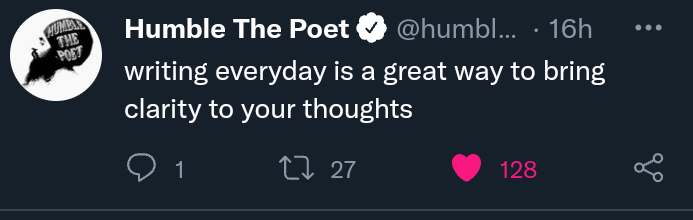
When you write, you’re training your mind to focus on a specific topic and stay with it. When you write, you unlock a whole new level of focus and self-discipline, something that can be useful outside of writing and in your daily life.

Writing is essentially about clearing up your head from the racing thoughts and placing them all down for better inspection and simply for the sake of having a clear mind to focus on other things.
When you’re in the habit of writing, you’re forcing yourself to put the effort to focus and be present – something which we all need in the present times.

Words As Therapy


Words As Therapy

• Writing, as a habit can be really theraputic. Dealing with a million emotions can be challenging, but when you externalise those feelings and emotions, your mental health improves and the overwhelming feelings stay at arms length.

• Expressive writing, or writing for expressing one’s own thoughts and feelings into words is one of the most common ways of self help and just calming oneself.

• When you write or journal about your own negative experiences, you allow your mind to sort out the thoughts and process them, which allows you to deal with situations and even come up with solutions to difficult situations.

• Gratitude journaling is a great tool to maintain a healthy mental space. Writing about things, people and experiences you’re grateful for can be a great reminder about all the good things in life and things that are worth going forward for.

• Letter writing is another, underrated habit of writing. Many times, things left unsaid can bother us. These things, to others and to ourselves can be written down in letters and be therapeutic and relaxing.

Words At Work


Writing can be useful,not just for personal life, even for your professional life.

• When you write down the many thoughts going on in your mind you leave space for more productive processing to happen in your head.

• Noting down important things happening in your day to day life, just as simple notes or to do notes can be a very easy way to categorise and organize work which helps you have a clear head, helping you be pay attention and be present at work.

• Aside from that, writing can be a great way to learn communication skills. Writing and publishing your own words to a certain number of people increases your self confidence which in turn, helps you build better work relationships.

• When you build a habit of writing, you automatically learn the art of expressing yourself clearly without using fancy words. When you have a clear language and mode of communication, you can express yourself without fancy big words.

• Good writing habits also reflects on clear, concise thinking, being a good writer you can have structured thoughts and a better outlook towards the work which automatically improves the quality of work.


But what if you actually want to start writing,but you can’t get past a certain point?

Here are some Tips To Deal With Writing Fears


Many times, it’s not the writing process,it’s the thinking process that doesn’t allow you to start. It’s important to know what to write before you actually step into it.

Read on a large span of topics. Read everything – things that interest you and those that don’t, eventually find a topic that you feel comfortable writing about.

Then, spend some time thinking about what to write on that specific topic. Working out, commuting to places, going to bed, use these times to think about ideas and find inspiration from things and people around you.

Once ideas start coming in your mind, write them down, each one. Don’t look for a specific ‘good’ or ‘bad’ idea, write everything down, you can sort through the ideas and edit them all later.

Once you’ve written something you’re proud of, read and re-read it, your mind will realise that it is actually a soothing experience and actually worth the effort, that way, you will be motivated to write more.


Something that a lot of writers are scared of is “the writer’s block”. It is basically when you don’t have the inspiration and/or motivation to write new and interesting pieces.

How To Deal With Writer’s Block?


• For many of the modern writers (including myself), procrastination is a major roadblock. So essentially, it is important to build the will to actually get up and get to writing.

• Another reason for experiencing writer’s block can be your environment. Suddenly changing your surrounding or being surrounded by the same things for long periods of time can impact your productivity as well.
Try making small changes to your workspace at regular intervals, also try to have fresh light coming in – a little light can go a long way!

• And finally, while writing, have no distractions around you. Close out all other programs or distractions and let your mind focus on the words and involve yourself in the process of creating beauty through words.

FACING OUR FEARS

With the new year many of us are making new year resolutions- eating healthy, working out, developing new hobbies, practicing self-love are some of the many that I’ve heard from people around me.
But here’s one that I’ve not heard from anyone that I think everyone should persue (or atleast try to) and that is – facing our fears and growing from them.

A question that came to my mind was,

Why face our fears?


Isn’t it much more easier to just let things be as they are?

Well, yes. It would be, but think about it, the last few years (2020 & 2021) have been pretty tough, how much worse can it get?
Might as well take the risks and see how it goes. Because life is all about taking risks and overcoming fear. If you don’t take that leap today, you’ll never know what you’re capable of.

If we embrace our fears and work on them, we can break the biggest ceiling – our own mind. Once we do that, everything will be limitless! When we work on the things that we fear, or even simply acknowledge it and put some thought into it – we take away its power to control us.

If you don’t work on that one thing that is constantly at the back of your head, that one thing that makes you stay up at night and worries you throughout the day, it will consume your mind entirely and will not let you reach the success that you’re aiming for.

We all need to face our fears and challenge ourselves to acknowledge these fears in order to rid our mind of the emotional baggage that these fears bring into our lives.

But let’s be honest , it’s all easier said than done.
So the biggest question,

How do we face said fears and grow?


1) The first thing to do is to realise that being afraid of things is common human nature. We’re all humans and we’re all afraid of something. It’s not about not being afraid, it’s about how you handle those fears and how you grow from them. Know that fear is mostly an uneasiness our mind feels over things that we don’t know about, or we’re unsure about.

2) The second – and maybe the most important thing, is to know what you’re afraid of and to what extent. It may sound strange but many people (including myself) aren’t exactly sure of what they’re afraid of.
Take some time off and sit down and think about the things that bother you/worry you.
When you know exactly what to work on you can actually focus in that direction instead of feeling stuck . When you know exactly what to work on things become more manageable and less scary.

3) Try to identify exactly what triggers fear and worry into your head. Sit down with yourself and just think about those things and the emotions they bring up inside you without actually feeling those emotions or letting those emotions control your mind.
It might seem difficult at first, but slowly ease yourself into the process, eventually, you’ll be able to process those thoughts and emotions without really feeling much of them.

4) Like I said before, fear is (to some extent) an uneasiness in our mind about things that we don’t know about, or things that are ‘the unknown’. So gather as much information as you can, the more you know about it, the less scary it will be, and you might even find it interesting!
Also, telling someone about your fears can be a great way to elevate some of the stress and can help you think more clearly. Writing those fears down can also be a great way to acknowledge them, it will help your mind to come up with solutions much more easily.

5) Use your imagination to think of the worst case scenario that could happen if you go forward with chasing these fears – and maybe even conquering them.
Then, make a plan of what you could do if such a thing was to happen.
Once you acknowledge the worst case scenario and find out ways to come out of it, it becomes way more easier to deal with them. It will help you take your mind off the problem and you can actually put in your energy to working towards the goal.


With all this said, you need to know a few more things before going into this journey.

When you start off, there will be times when you would feel overwhelmed, you might feel like you’re not getting anywhere and all of this is just a waste of time. At times like this, reflect back to what things were like before and how far you’ve come.

Know that all the hard work and unhappiness you’re feeling now is for something far more greater.
Whenever you’re feeling emotionally burnt out and frustrated, take a break, listen to soothing music and process what’s happening around you, only then will you be able to move forward.

At the end, always remember that there is no greater feeling than overcoming fears and barriers, the feeling of coming out of it as a better person on the other side is simply irreplaceable.