On Creativity

A ‘creative head‘ is how I’ve described myself to people for many years, since I’ve always thought of myself as someone who has a creative vision and can find odd ways of turning one thing into another and seeing things in ways which others don’t always notice or even care to look at.
But recently I’ve gotten more into asking questions about it – what does creativity mean and does it mean differently to different people? What is ‘creative vision’? And what is creativity even about?

I’ve gotten a lot into thinking about creativity and that’s what I want to talk about – let’s talk about creativity.

What does it mean to be creative?

To be creative, in the most simplest sense, means to use one’s imagination to create something. When we speak of ‘creating something’ it is often thought as creating something new and original, something that has never been made, something truly mind boggling and innovative. While all this might be true in some instances, it is not true for all creatives out there. Most creative ideas are about making new connections between old ideas in order to creating something different.

Creativity is about using old methods in newer ways to find solutions for problems or making things using new connections between old ideas.

With the ever consistent change in reality, new and improvised creative ideas are more and more welcome and we tend to see a lot of these in mainstream media too. All those ‘gadgets’ and ‘hacks’ we see around us that are bound to make life easier are all a result of somebody’s creative thoughts.
While some of these hacks and gadgets seem silly and a waste of time to most (*ahem* 5 minute crafts *ahem*), some of these do actually work – and when you do find any such hack that might actually change your life, you can thank someone’s creativity for that.

And if you’re wondering the same thing as I am..

What do I need to be creative?

It is often said that creative people are born as such and that it us something inherited. While it may hold true , there is a certain level of creativity that everyone is born with, it just needs the right push to come out fierce and strong. For each individual to show off their creative side all they need is the right guidance and the proper environment to raise that creativity to reach their true creative potential.

Know that almost everybody’s hidden creative side can be pulled out to shine in it’s own unique ways and that creativity is different for all – it comes in all different ways, shapes, sizes, qualities and quantities.

Scientifically speaking, there are a few cognitive skills that you’ll need to develop in order to have the most efficient creative thinking.

  • The ability to generate new ideas – be it original or from combining old ideas to create something better.
  • The ability to retain things in memory and easily go back to things in memory. To reach back to stored or old information – at the right place and time.
  • The ability to interpret ideas from one’s own experiences and associations by being attentive and present in each moment.
  • The ability to easily snap out of generic routines and accepting sudden change.

Now, after reading that, if you think that you have what it takes to be creative, then you might ask yourself…

Why do I need to be creative/what does creativity bring to my life?

In the most simplest way – creativity brings 2 main benefits to our lives

  • with the everyday stresses and troubles of life creativity is like a gateway to mini paradise. A place where you can be away from your problems and create things that make you happy. It allows one to step away from existing train of thought, do something different and come back to the problem with a clear head.
  • creativity allows one to look within themselves – it provides a window to peek within ourselves and find out exactly what we want and don’t want in life. It’s the best way to learn ourselves and develop a better relationship with ourselves.

Now, have I sold you on being creative? I hope I have! And if so, then allow me to introduce you to some tips on

How to be Creative

1) stop judging your own creative ideas. Give yourself the permission to do what you love and laugh off the mistakes you make along the way.

2) instead of simply brainstorming, thinking and planning your creative visions, actually make something! Put the fear of uncertainty behind you and get to work – create!

3) give yourself enough time to create something, but stick to a schedule. Letting yourself too much time for something will only lead to procrastination and delay.

4) churn out as many ideas as you can. It doesn’t matter if they’re good or bad – think of new things and don’t hesitate to put it out. Remember, the best ideas often hide between the most mediocre ones.

5) put your ideas out infront of people. It may feel daunting and scary to take that stand but showing your work infront of people holds you accountable for it and helps gain new perspective.

Besides this, there are some more things you should know as a creative.

Inspiration – You won’t always get hit by a lightning bolt and get the Eureka moment that will lead to crazy breakthroughs. Sometimes inspiration won’t hit you in the most magnificent ways, instead, it can be something as small as a ladybug on a blade of grass. You need to be able to have a broad mindset and see things differently.

Getting in flow – Creativity is not something you can randomly pick up whenever you want and drop whenever you feel like. To excel at creativity and reaching to your level best, you need to be consistent. Creativity is about constantly coming up with new ideas, improvising and re- building things. To reach a “flow” state in creativity you will have to be consistent.

Solo or team – Creativity requires the best minds and the best of minds. While being a creative does mean that collaborating with the best minds around you is essential, allowing the best of your own mind to come forward is also of equal importance. Bringing out the best in you will require solitude and being alone with your own thoughts and ideas. Remember, the best creative minds tend to be introverts and spend their time with themselves while also valuing the response and ideas from the people around them.

“Creativity involves breaking out of expected patterns in order to look at things in a different way.”

~ Edward de Bono

A Little More On Procrastination

I’ve spoken about being a major procrastinator many times, but it’s time to go a little deeper into it and learn more. (If you’re a procrastinator like me and you’re reading this, chances are you’re procrastinating something right now, think about what it is.)

What does it mean to be a procrastinator?

To procrastinate means to delay something that needs to be done as soon as possible and actively finding ‘better’ things to do rather than doing the things that need to be done.
It’s knowing fully well, the consequences of delaying something yet doing it only to face trouble at the end – be it by rushing through work or a project or having to listen to long lectures from seniors.

Procrastinators are these exact people!
We tend to put everything till the very last moment knowing fully well the negative outcomes of it yet focusing our attention towards things that are less attention demanding and something that can distance us from the work that needs to be done in the present.
Procrastinators tend to have a much more optimistic idea of time and tend to push everything for later thinking they’ll ‘manage’ everything just fine. (Which is mostly just putting their luck to the test)

But then why is it that people tend to procrastinate?

(According to so many different sources)

It is commonly said that procrastinators only procrastinate to distract themselves from their fears of failure or inability to commit themselves to a particular work or continuously do it for a long span of time.
They tend to procrastinate only to have more control over their emotions.

According to some studies, procrastinators don’t really have control over their habit of procrastination, for them it is a response behaviour towards extreme authoritarian lifestyle one has had in the past or even in the present.

According to some other studies, procrastinators procrastinate because they tend to prefer the “now” and value how they spend it instead of planning or worrying about the future.
They prefer having fun and enjoying the present rather than waiting for it in the future.

Some studies also claim that most of the procrastination done by the average person is unconscious and can probably be avoided if people simply focus more on their everyday life and be more organized.

There is also the final group of people that think the people who procrastinate do so because they lack the motivation to actually work and are unaware of the powers of their own emotions – of the present and the future and the role these emotions can play in getting the motivation they need for getting things done.

But what is the actual reason for procrastination? Why is it that we feel so much better just pushing things to the side and instead focusing our attention to less important, more fun tasks?
The answer to this could be absolutely anything – it would differ from individual to individual, you will just have to look within yourself for this one.

Now if you do actually realise how or more importantly why you procrastinate – is there any way to stop procrastinating?
In the most honest way – no, there isn’t something you can do that will magically change you from master level procrastinator to the diligent, hardworking, good child.

You can’t change yourself just magically, but there are some things you could do to make procrastination better for yourself.

How to use procrastination better?

-> The first and maybe most important thing is to embrace procrastination as a part of yourself. Know that you can’t change everything about yourself, so instead of finding ways to change it and look for ways that you can be yourself and still get work done while being happy.

-> The most difficult step is putting aside distractions and getting to work. It’s really easy to say “Just do it” but real life application of that is a lot more difficult.
A few steps to consider before saying “Just do it” are
1) make a to do list – preferably with more easier tasks at first and the tasks getting progressively difficult.
2) making a mental (or physical) note of each thing you have to do and alloting time to it based on how long it will take you to do that specific task, and if you can, allot yourself some extra time just incase.
3) use deadlines to your advantage – while alloting yourself time to work on something keep the deadline in mind and allot yourself a timeline which ends earlier.
4) create “punishments” for yourself for work not done (no, don’t go beating yourself with a lamp like Dobby), make the punishments something that will test your self control, for example, something like no sugar for a whole week or not going on social media for a week.
5) control the distractions around you – as much as possible. It isn’t easy to turn everything off and live like a monk, and it probably isn’t the most wise thing for many people, but try to limit the distractions around you and try to hold yourself accountable for the things around you.

-> When setting up to get into the work zone know that it takes time to get into the rhythm of work and different types of tasks tend to have a different rhythm to it. So when you place work for yourself, try to group out similar tasks together to stay within the similar rhythm and not having to switch your mind from one type to another type of task.

-> When you get into the “Just do it” mindset, remember that it won’t necessarily last for hours. So whenever possible try to write down all the things you need to get done and the possibile steps to do it and the things to keep in mind – this will be your blueprint.
So the next time you feel even the smallest bit of energy, pass a glance at this blueprint and that will give you the idea and motivation to finish the task at hand.

-> Speaking of motivation – know that simply having an idea in your mind or a goal ahead of you won’t always motivate you to stop slacking and start working. Sure, it does help to have a visual idea of what you’re working towards, but sometimes feeling instead of simply seeing can be more help.

-> Lastly, learn that overcoming procrastination and using your bad habits for your own advantage will take some time and a lot of effort and relapsing back can be completely normal but you need to be able to overcome those hurdles and not fall back.

Being Busy Is Good?

In today’s time, we as a society have glorified the idea of being ‘busy‘. People that are seen constantly stressed, buried in their work are viewed as more accomplished than someone not swamped by work and worry.

Today’s hustle cultre views these so called ‘hard-workers‘ as the image of the ‘perfect employee‘ and holds this standard of being busy on a pedestal.

Is being busy actually bad?

No, it’s hard to say that everything about hustle cultre or being busy is bad. But it’s definitely a point to note that these do glorify the idea of constantly being on the go and working and have even made it the norm for today’s generation to constantly be working and measuring their own self worth by how much they’ve accomplished.

Think about it, how many times have you criticized yourself because you didn’t do ‘enough work‘ or you didn’t ‘work harder‘?
How many times have you actually been happy on a day off and been glad that you took care of yourself?
Have you ever felt miserable for taking the weekend to rejuvenate and work on things that make you happy instead of working extra?

According to the standards we’ve created for ourselves, anyone who isn’t busy and doesn’t spend every second immersed in work simply doesn’t stand up to these standards and is just termed as ‘not hard working‘ or simply ‘lazy‘.
This outlook of society makes us judge our own self worth by the amount of work we do and the labels society puts on us.

Glorifying the idea of always being busy tends to make us much more about self and can, in a sense, make our thoughts and actions even more selfish.
We tend to get more stuck in our own little world excessively brooding about our own work and our own problems which obviously have a negative strike to our mental health but also end up in us neglecting close friends and family.
Cancelling plans last minute, not being present for special occasions and being missing from important moments tends to become ‘normal‘ for busy people.

Now, once or twice these actions may be ignored or forgiven but constant occurances tend to leave cracks in relationships which might eventually leave you feeling lonely and distant, unable to maintain those relations.

The current idea of busyness doesn’t necessarily put in ‘quality of work’ as an important factor, instead, ‘quantity of work’ becomes the deciding factor.
When we place priorities in the wrong areas it does end up being counter-productive and instead of actually getting things done we might only be wasting precious time.
It’s necessary to keep track of how and what you spend your time. Know if the time you spend on doing something is actually for something ‘productive‘ or is it just being busy.

How to know if you’re actually productive or just busy?

Being ‘busy‘ isn’t something you’re forced to do, it’s a life choice – something you make and continue.
Know that being efficient isn’t about the number of hours you spend doing something that may or may not have a positive outcome. Efficiency is about the number of positive results you get on doing things.

Think about the things you do on a daily basis that you think are ‘productive‘ – does it actually give outcomes that help you grow? Does it help with things you’re struggling with/find difficult?

Being busy is just about passing time doing things that seem productive,while actually, using time for things that support growth is real productivity.

Answering emails is one such task that might seem and feel productive but it has more cons to pros. It doesn’t matter how many times a day you check your email, you can always expect more to be there eventually. It always makes you feel productive but in reality it just gives you that extra stress that hampers with actual productivity.
It’s often advised to check your emails only once or twice a day to allow some actual productivity instead of spending hours each day in ‘pseudo-productivity‘.

But why is it that we fixate ourselves in pseudo-productive work?

When we’re constantly under stress and lose work-life balance (which is a consequence of hustle cultre) we tend to mess with our attention span, and the constant pressure from work and personal life harms the cognitive bandwidth.
Even though having narrow cognitive bandwidth might help you hyperfocus on something, it also has its cons – popularly termed as Tunneling.
Tunneling, according to dictionary.apa.org is defined as

"a psychological state, typical of people concentrating on a demanding task or operating under conditions of stress, in which a single, narrowly defined category of information is attended to and processed. "

In the most simple terms, tunneling is being extra focused on things that are right infront of us that may not be so productive, which is caused by extreme stress in our lives.

A definite point of importance is that when we become so fixated in our own lives doing ‘productive’ work, we tend to have less time for things that actually matter, like our own physical and mental health.
We tend to have less time for decisions that affect us, instead we make impulsive decisions because taking cautious, calculative steps isn’t an option anymore.

So how can we get rid of busyness and make time for things that actually matter?

• It might make us feel important to be constantly busy and get that validation from society. But remember that the same busyness has long term effects on your health.
These long hours of stress and lack of sleep and completely ignoring self-health can lead to problems like headaches, insomnia, fatigue, seizures, etc. When you make changes in busyness, you will only have positive changes in your physical and mental health and will improve relationships with people you’ve been pushing away.

• Take a deep dive into the work you’re always busy doing – then think if spending all that time and resources is actually a wise decision. Spend time doing things that you actually find valuable – does it feel productive?

• Learn to ignore the voices, views and opinions of society that promotes hustle cultre and being busy. Keep in mind the actual goal you have, that which you strive for. (I know it’s so much more easier said than done, but give it a shot!) Challenge the idea of being busy and go for what you believe you want to do.

• Understand the importance of saying no to things that don’t serve purpose to your life, instead, spend that time on things that drive you and things you find yourself excited to do.

• Sometimes you can find true satisfaction in doing less. You could do hundreds of tasks a day but they won’t necessarily bring you happiness, but even doing one task that drives you can be the source of your happiness.

• Encourage yourself and people around you to get the image of being busy out of their mind and instead set being productive as the idealistic mindset.

Unlearning

The 21st century has been the time of great discoveries, inventions and learning. With all this learning comes even more new things and concepts that might seem strange to some, but it is absolutely necessary for us to learn these to move forward.

One such concept is “Unlearning”.

But an important question to ask would be

What is unlearning?

When you remove something from your memory, you lose it and never think about it again and eventually it fades away from your mind leaving space for new, important information – that is unlearning.
Living in today’s day and age, it is a necessary skill to have.

Unlearning old activities/skills that once seemed useful and productive and replacing it with skills much more valuable, new skills that can help you get ahead and take your community forward – this is a very important skill, one which might seem really difficult (and even is, if we’re being honest) but is necessary nonetheless.

As it is a fairly new concept, it might be difficult to fully grasp it and more importantly, to understand it’s purpose.

Why is unlearning necessary ?

As said before, people need to develop unlearning to move forward and carry society forward side by side, to have better work ethic and overall have a new, fresh outlook towards all aspects of life.

The concept of unlearning forces the mind to constantly learn, re-learn and discard old learnings ; keeping the mind fresh, agile and sharp.

It isn’t necessarily important that everything you learnt or the skills you developed in the past have to be useful to you in the present or in the foreseeable future.
Unlearning is all about removing the unimportant/useless skills/information from your mind and clearing up space for much more productive and useful things.

There is also a high chance that whatever you re-learn isn’t the complete opposite of what you had previously learnt, instead, it could just be a modification of the old information/skills, morphed to suit you better.
But this requires expanding your mindspace to allow more and new information, which will definitely require you to get rid of the old clutter occupying your mind.

Also, if you’re someone who likes to constantly change things up, especially when it comes to professions and/or hobbies or if you’re simply looking into jobs, unlearning can be a great skill to have as many new, up-and-coming businesses and workspaces prefer having employees who can manage many skills and are easily adaptable to new and sudden changes.

Someone who is constantly unlearning and developing themselves is seen as a risk taker and someone who isn’t afraid to make changes, no matter how sudden or random they seem, which is another great impression to keep of yourself.

Now, to some people, the concept of sudden changes of learning and re-learning and even constant changes in life might seem strange, difficult and even scary.

How to develop unlearning ?

1) When you make the decision to develop unlearning in your skill set, it would mean you have found previous knowledge/skills inadequate to help you hustle through some important tasks and projects or maybe you simply wish to make room in your head for things that align with your present day priorities.
Either way, seeking new knowledge should be the very first step of your unlearning journey.

Only when you gain all that new knowledge will you be able to replace the old information with it or add more to your skill sets. So make it a point to constantly read and surf the net on subjects that you find interesting and constantly update yourself on new changes happening in that field.

2) Another way to gather more information and learning more is by talking to more people .
Build the habit of going outside of your social circle and meet new people and try to start intelligent, insightful conversations.

Try to talk to people having the same interests as you to learn more about your present day interests and priorities, but if you’re trying to learn new skills or trying to find even more skills, talk to people having complete different interests and educate yourself about their field of work and interests.

3) It is very easy to be in our own bubble of comfort and enjoy the safety of everything that we know. But to develop unlearning, one must venture out of this comfort zone and experiment in life.

If you can, travel and experience different places, cultures and people. Or simply make bold choices in life, choices you may not make in the safety and security of your comfort zone.
Go beyond what feels normal and ‘okay’, go for what makes your heart race with excitement.

4) When you experience new people and places, you clear your head of useless clutter in your mind.
Then comes the best and difficult part – relearning.

It’s the best thing because relearning allows you to use those new experiences and process them in your mind to update your existing knowledge about something or learn new things and improve yourself.
At the same time, it’s difficult. You need to be open to new and different perspectives and opinions and learn to accept ideas and concepts that go against your general/old understanding.
It’s also difficult to create an environment, both physically and mentally, that allows easy relearning.

5) When you’re able to reach a place where you’ve discarded information not useful for you and updated it with new and advanced learnings – you reach the finishing point.

You reach a stage where you’re a little more knowledgeable and a little more advanced, but don’t think this to be the end. It is merely another phase of the unlearning journey, because unlearning is a forever cycle.

Even we know all this, but surely there must be something that might just make the process a little easier…

Things to keep in mind

  • Instead of completely flipping your life around and making drastic, dramatic changes, start off slow. Make small changes in your life to replace previous habits/tasks and work your way up to more difficult tasks.
  • To begin unlearning you need to learn that your past tactics won’t be useful forever. It’s about making that realisation that change is the need of the hour.
  • It’s necessary to have a constant look at your life, especially a view from outside, to be self aware. When you have that vision you’ll be able to predict which skills will and will not help you thrive in the future and that allows you to make changes to things that no longer serve a good purpose in your life.

Unlearning is something we all can benefit from, so whatever phase of life you’re in – consider giving unlearning a chance in your life and see how much it changes things.

Learning From The Past

Some people look back at thier past, to find happy memories, some find sad, hurtful memories, but the thing that will be common for everyone looking back at their past is that you can (and should) learn from the past.

The experiences, the people and the situations you were in – they all have a much bigger purpose in your life. They are there to help you learn and help you grow, for you to grow into the best version of yourself.

The past holds high notes of wisdom, notes that can change your present if you gain inspiration from it.

It’s fair to say that we’ve all had good and bad times in our past, times when we were happy, and times when we weren’t.

Always remember that life is like an everflowing river, constantly swirling and making new paths, sometimes carrying on with the old paths and sometimes making new ones.
No matter good or bad, your past can only control your present and future to an extent.

There is a fine balance between honouring the past and losing yourself in it.

Eckhart Tolle


We all have, at some point, made mistakes in our past, but replaying all the regrets from the past is not going to make any difference to the present.

The way to get over the regrets from these mistakes is to actually learn the proper lesson from it. When we learn from it, it is no longer a negative element in your life, rather, it becomes the positive aspect of our past.

Remember the lessons the past has taught you, but don’t let the fear from the past experiences affect the choices you make in the present.

We need to be able to learn from the past, but at the same time, it’s important to update those lessons based on the current situation and the person that you’ve changed into.

It's good to learn about the mistakes from the past and use them to make better decisions for the future but it's important to know that at the end, your mistakes only guide you, they do not reflect who you are. 


We can’t change what’s already happened, so instead of thinking of those times, it’s important to grow into a better version for the present and the future.
Try to see the past as training for a better future and use the lessons to grow.

The way to actually grow from the past is to firstly have the self-realization and courage to accept the mistakes you made and acknowledge it’s consequences.
It’s important to have the courage to make changes to your actions to make changes for the future results.

Have the courage to recognise the behaviours from the past that are negatively affecting your present. Analyse those behavioural patterns and their affect on you.

Then, take responsibility for your actions and the mistakes. When you take the responsibility,it becomes easier to actually accept it and move on and also stops you from always bringing up the past and blaming others for the mistakes and problems you faced in the past.

Bringing up the past and blaming others for the bad in it is never going to lead to anything positive and will hinder your relationship.
We bring up the past and try to connect it with the present when we feel like we’re not in control of the situation, what we need to understand is that it does not help the situation at hand and instead pulls the focus away from the main issue.

Instead of holding grudges with people connected to a sad past, try reasoning with them and having conversations. Resentment only takes away power and energy from you, forgiveness sets you free.

Fear not for the future, weep not for the past.

Percy Bysshe Shelley


Once you understand and accept the past and every thing in it – good and bad, it becomes easy to learn from it and steer into a better future.

Teach yourself better ways to deal with situations and people. Teach yourself to actually be present at the moment and most importantly, teach yourself to be responsible for your actions and think about the consequences it can have in your future.

The best thing about looking at the past is all the good memories. Whenever you feel low or unmotivated and need something to cheer you up its a good exercise to look back at the times when you were in a better state of mind and felt powerful.
Think of the times when things went your way and you were productive and made positive changes to your life.

Try to remember things to the last detail and then use the same energy that you felt then. Manifest that power back into your life and harness that energy to drive away the negative energy surrounding you (sort of like the Patronus charm – Expecto Patronum ! )

The Power Of Words

A pen is stronger than a sword” is a quote we’ve all heard at some point, and it’s true! Words have a power than nothing else has.

Writing is taking small, baby ideas and turning them into concrete pieces. People use their words to express themselves, some through journaling, some by writing stories, poems and prose, some even use their words and express themselves through captions on social media.

But, what about for someone who doesn’t really express themselves through written words? Or a more appropriate question to ask would be

Why To Write?


There are many reasons to write, but something to keep in mind is, you need to have the will to write.
To weave those words with the thoughts in your head, the rush you can get from writing down things that have meaning to you is simply different and irreplaceable.

The feeling of creating a masterpiece with words is something really precious to every writer.

When you write, you’re training your mind to focus on a specific topic and stay with it. When you write, you unlock a whole new level of focus and self-discipline, something that can be useful outside of writing and in your daily life.

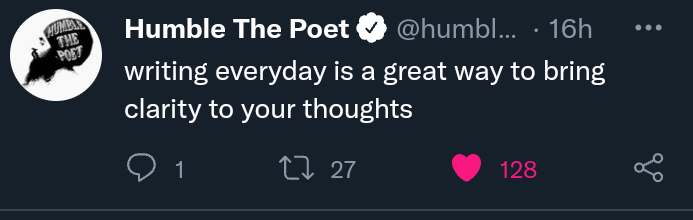
Writing is essentially about clearing up your head from the racing thoughts and placing them all down for better inspection and simply for the sake of having a clear mind to focus on other things.
When you’re in the habit of writing, you’re forcing yourself to put the effort to focus and be present – something which we all need in the present times.

Words As Therapy


Words As Therapy

• Writing, as a habit can be really theraputic. Dealing with a million emotions can be challenging, but when you externalise those feelings and emotions, your mental health improves and the overwhelming feelings stay at arms length.

• Expressive writing, or writing for expressing one’s own thoughts and feelings into words is one of the most common ways of self help and just calming oneself.

• When you write or journal about your own negative experiences, you allow your mind to sort out the thoughts and process them, which allows you to deal with situations and even come up with solutions to difficult situations.

• Gratitude journaling is a great tool to maintain a healthy mental space. Writing about things, people and experiences you’re grateful for can be a great reminder about all the good things in life and things that are worth going forward for.

• Letter writing is another, underrated habit of writing. Many times, things left unsaid can bother us. These things, to others and to ourselves can be written down in letters and be therapeutic and relaxing.

Words At Work


Writing can be useful,not just for personal life, even for your professional life.

• When you write down the many thoughts going on in your mind you leave space for more productive processing to happen in your head.

• Noting down important things happening in your day to day life, just as simple notes or to do notes can be a very easy way to categorise and organize work which helps you have a clear head, helping you be pay attention and be present at work.

• Aside from that, writing can be a great way to learn communication skills. Writing and publishing your own words to a certain number of people increases your self confidence which in turn, helps you build better work relationships.

• When you build a habit of writing, you automatically learn the art of expressing yourself clearly without using fancy words. When you have a clear language and mode of communication, you can express yourself without fancy big words.

• Good writing habits also reflects on clear, concise thinking, being a good writer you can have structured thoughts and a better outlook towards the work which automatically improves the quality of work.


But what if you actually want to start writing,but you can’t get past a certain point?

Here are some Tips To Deal With Writing Fears


Many times, it’s not the writing process,it’s the thinking process that doesn’t allow you to start. It’s important to know what to write before you actually step into it.

Read on a large span of topics. Read everything – things that interest you and those that don’t, eventually find a topic that you feel comfortable writing about.

Then, spend some time thinking about what to write on that specific topic. Working out, commuting to places, going to bed, use these times to think about ideas and find inspiration from things and people around you.

Once ideas start coming in your mind, write them down, each one. Don’t look for a specific ‘good’ or ‘bad’ idea, write everything down, you can sort through the ideas and edit them all later.

Once you’ve written something you’re proud of, read and re-read it, your mind will realise that it is actually a soothing experience and actually worth the effort, that way, you will be motivated to write more.


Something that a lot of writers are scared of is “the writer’s block”. It is basically when you don’t have the inspiration and/or motivation to write new and interesting pieces.

How To Deal With Writer’s Block?


• For many of the modern writers (including myself), procrastination is a major roadblock. So essentially, it is important to build the will to actually get up and get to writing.

• Another reason for experiencing writer’s block can be your environment. Suddenly changing your surrounding or being surrounded by the same things for long periods of time can impact your productivity as well.
Try making small changes to your workspace at regular intervals, also try to have fresh light coming in – a little light can go a long way!

• And finally, while writing, have no distractions around you. Close out all other programs or distractions and let your mind focus on the words and involve yourself in the process of creating beauty through words.

TOP TIPS TO BE PRODUCTIVE

We’re all humans and we all have dreams and goals, some big and some small, but the only way to reach these goals is by working towards these goals. But if you’re a procrastinator like me being productive and getting things done might be difficult. So here are some tips that might just help you be a better version of yourself.

TOP TIPS

1) Know your daily goals

This is the first and most basic step to being productive. This is important because not knowing the goals for the day makes us random and it takes much more time to get things done.
The best way to do this is by a to-do list. Write it down, either on a paper, or an app on your phone or even on your calendar, just note it down somewhere so your brain doesn’t need to remember all these tasks, it can just focus on the work at hand.

Pro tip – Instead of deciding all the things and tasks in the morning and wasting precious time, write it all down the night before, that way you can wake up ready to hustle.

2) Map your day

Map out the things you have to do, don’t just write down random words or vague sentences. Write down the actual steps and plan of action that are clear. This way you will have the exact steps lined up for you and you can do your work with lesser things going wrong.

3) Prioritise

Know the most important and crucial tasks of your day and start working on those.
When making a to-do list try to break up the task into smaller mini-tasks and get to work on the first one in the sequence.
Finishing the first task will encourage and motivate you to work on the remaining mini-tasks and it will be easier to finish the task.

4) Goals and times

We only have 24 hours in a day, so we need to put every minute to work.
After organizing all the tasks, assign due dates and timers as much as possible and try to get things done within the alloted times.
Develop the habit of working fast while doing the best that you can. (It’s not easy but practice makes perfect… or atleast the thing closest to perfect)
Also, try to get onto a task and finish it as soon as possible instead of pushing it away for some other time.

5) Track yourself

Keep an eye on your to-do list and your timing. Review these often.
Keep track of your to-do list to make sure that you’re not overworking and doing work that is not necessarily important.
Keeping track of your timing ensures that you don’t spend too much time on a particular task and that you distribute and use your time effectively.

TOP MISTAKES

1) Time crunch

Not giving enough time to complete a task is a mistake all of us have done at some point. It’s important to not take too much time to do a task but at the same time it’s important to allow yourself enough time to complete the task successfully.

2) Assumptions

… specifically assumptions that everything will go right. Always assume that there will be hurdles along the way and allot sufficient time to deal with these problems.

3) Not enough vision

Not having the proper vision and goal will just increase the number of hurdles that come in your path. Make sure that before you begin anything ( a project, a task, an activity etc) you have a clear vision and you know the path to that vision.

4) Stress

Constantly stressing out can put your mental and physical health at risk. It will also effect your productivity. Identify the stress causing factors in your life, develop ways to de-stress and if possible, avoid these stress causing media.

5) Depending on yourself

Don’t get me wrong, being independent is a great thing and often times it seems like the best course of action. But in most cases, doing everything by yourself can lead to eventual burnout.
We’re all humans and we all have only a specific amount of energy in a day, it is impossible to expect ourselves to do everything on our own.
Get help, it may be in the form of an app or a device that helps you organize your day and other small things like that or maybe even hiring people to help you out in your work.

EXTRA TIPS (because why not)

Remove distractions – delete apps, place your phone out of reach and turn off notifications.
• Focus on one thing at a time.
• Keep your home and workspace clean and organized to avoid chaos.
• Get the proper amount of sleep.
• Exercise regularly.
• Eat healthy.
• Take breaks in between work.

If you want anymore tips on how to work efficiently then check out my other blog post here:-

https://anublogsofficial.art.blog/2021/05/23/how-to-work-efficiently/


(Shameless plug 😉 )

TOP TIPS TO COMMUNICATE

If you’re an introvert, trust me, this blog is definitely going to help you express yourself and build your confidence. On the other hand, if you are an extrovert then you too can be benefitted by this blog, it will help you deliver your message across more openly and clearly. 😉

So, let’s begin!


WHY IS CLEAR COMMUNICATION IMPORTANT?

Effective communication is really important for an organized life and it is far too important to ignore or leave to fate.

When you strengthen your communication skills you eliminate unnecessary rework and wasted time from misunderstandings.

Poor communication or bad communication skills will just make life harder for you. It will be the root cause for various misunderstandings, conflicts and confusions which can go on to affect your productivity as well as relationships.

It is better to be a frequent and open communicator who can easily talk about things and problems rather than being an under communicator.

During difficult times under communication can cause troublesome situations.


QUICK TIPS (GENERAL)

When communicating, especially about important things, stick to the topic and try not to add too much unnecessary information since it might confuse the recipient.

Know the objective of the conversation and be clear about the message.

Don’t rush into conversations, take a few minutes to collect your thoughts and calm your mind and deliver the message in a straightforward way.

Keep in mind the type of people you are communicating with and frame your message according to it.

Make sure that the recipient has understood the message clearly. You can check this by asking them to repeat the same information to you. It will help avoid any and all confusion.


MOST COMMON MISTAKES

Communicating with everyone the same way. (Realise that different audiences require different communication styles.)

Less questions, more assumptions.

Less listening, more talking.

Small minded thoughts. (Try to keep an open mind for everyone’s opinions and views.)

Negative approach towards the conversation. (Using negative tones and words creates an emotional distance between you and the recipient.)


QUICK TIPS (FOR INTROVERTS)

Challenge yourself and move out of your comfort zone.

Be the first to start a new conversation. Many people around you may feel the same way. So forget about your worries and reach out to new people.

Take a minute to think about the things you want to talk about. Have questions ready that will help you begin new conversations.
Pro tip – Try thinking of topics which you’re comfortable with or maybe a deep and meaningful topic, that way you can have a long conversation without any awkward small talk in between.

Once you start a new conversation, try to ask as many questions as possible and practice listening.

Try to relax and enjoy the conversation and don’t stress out too much.

Problems tend to build up more when we keep them bottled up inside us. If you’re having a problem with the people around you, try to communicate about it openly and find a solution to it or come to an agreement that works for everyone involved.


QUICK TIPS (FOR EXTROVERTS)

Ask questions and get feedback from people around you.

If you make mistakes, communicate with the people around you and try to understand where you went wrong.

Whenever a bad situation comes up, try not to point the blame at the other person/people.

Instead of using phrases like “You didn’t…” or “Because of you…” and “If you didn’t/hadn’t…” try using phrases like “It hurts me when…” or “I couldn’t…” or “It is an inconvenience for me when…”. The other person will be less defensive and will be able to understand the issue from your point of view.

During problematic situations, once you explain your point of view, take time to hear out the other person and try to understand the situation from their point of view as well.


IMPORTANCE OF LISTENING

Listening is the other half of communication and is overlooked most of the time.

The true benefit of listening is not for the speaker but for the listener.

Being able to listen and understand to other people and their ideas and implementing those to our own is a very great trait to have.

Make effort to be a good listener. When you can listen to someone and understand them properly, you will be able to explain yourself better as well.


BEST OF THE BEST (FOR TOP COMMUNICATORS)

Make the effort to try and inspire others through your communication.

Try to spread important messages through your words and make a difference to the world around you.

Make conversations less about you and more about the people around you and the things that matter to you.

Instead of communicating about things that are negative and hateful, try communicating about kindness, truth, humanity or anything and everything else that you are passionate about.

Try to spread positivity through your words and through your influence.


That’s it for today. I hope you enjoyed it. Tell me, which of these tips will you start using from today??

PUSHING PAST THE NEGATIVE

Our brain has a tendency to view the world from a negative light. Once we start thinking about something as a negative, it tends to stick to us and makes it difficult to change our opinion about it. When we start viewing the world from a ‘glass half empty’ perspective, everything seems negative, sad and depressing. On the other hand, viewing the world as ‘glass half full’ shows a better, more happier perspective.

What that means is, having a better, positive mindset can change the way you view the world. Remember that your world is what you make it. Know that you can change your world. However, if you want to change it, you need to believe it.

Believe that you are in control of what goes on in your mind. You control how much space of your mind gets occupied by the negatives and how much space of your mind gets occupied by the positives. When you allow negative feelings and thoughts to consume your mind, you give them space, space that should be filled by the positive thoughts, feelings and emotions.

When we hold on to the negatives in our life, all the hurtful, sad, bad and cruel things in our life, we poison ourselves. It is a poison that slowly kills our creativity, passion and ultimately even love.

When you keep in negative thoughts and emotions you are wasting valuable emotional energy that you need to overcome the hurdels and reach your goals and dreams. You cannot become what you dream of becoming if you just sit around and waste your energy on thoughts that don’t matter and don’t bring any goodness to your life.

If you empty out the negative in your mind and heart you will create room for positive, you will make your mind stronger and make a better life for yourself. You will keep yourself happy and healthy.

We all have negative thoughts, emotions and feelings. But we also have the ability to make a choice, we can choose which emotions – positive or negative – do we want to fill our minds with.


In the words of Joel Osteen
‘ The scripture says “Give no place to the enemy”. It’s not just talking about forces of darkness. That means give no place to guilt, give no place to worry, give no place to bitterness. It can’t come in and automatically take over.’

You see, worry, stress, jealousy, resentment, anger, envy, regret, etc. These are all feelings that we all have. These are a part of life and everyone goes through one or more of these emotions atleast once in their lifetime. The key is not to hold onto these emotions. The best way to overcome negative emotions is not to stick to it neither is it about completely ignoring the feelings. To overcome negative emotions you need to go through the emotions. Let yourself feel bad and then move on, for yourself.

Recognize the emotions that are not beneficial, the emotions that are a burden and don’t let you move forward. Recognize these emotions and move through them. Move on and free yourself from the burden of the negative.

We have heard since a very long time that talking about the bad things in our life will make us feel better. We’ve constantly been told that venting about things would help us take the weight off our shoulders. So, we talk about the negatives, we vent and complain about all the things that are going wrong. What we don’t realise is that that just makes us stick to those negative thoughts for even longer.
Yet, for some reason, we never talk about the good things in our life, all the things that make us happy, all the privileges and blessings that we have in our life. Infact, research conducted at UC Davis has shown that doing things as small as writing for a few minutes a day about the things that you are grateful for can boost your happiness and emotional well being. So, it is important to know the positives in your life and regularly remind yourself about all these things.

Now, in case you are wondering how can we push past the negatives and be mentally strong?
I may have a few suggestions for you.

To be mentally strong you need to practice good mental health habits practicing gratitude and meditation.
But at the same time, you need to give up the bad mental health habits like holding a grudge or resenting someone else’s success.
You need to understand that these bed mental habits will hold you back from reaching your full potential and it will harm your mental peace.

To read more about mental peace band mental strength, check out my blog here:

https://anublogsofficial.art.blog/2021/06/07/how-to-be-mentally-strong-and-protect-your-peace/


But before that
Tell me, what changes are you going to bring to your life to make it better for you?

MANIFESTING YOUR DREAMS

The first question that you may have is, what is manifesting? According to The Millennial Grind by Kenneth Wong, ‘Manifesting is to assume the feelings of what you desire and using this aligned energy to bring it into your reality.’ In simple words, it’s making a wish and then working towards it, with a little extra help from a very special connection.

Have you ever wished for something very hard and very long and suddenly, it came true? If you did, then I think it’s safe to say that you’ve already made a connection with the universe/god/ultimate power/whatever-it-is-that-you-would-like-to-call-it! If you’ve not, then let me give you my top 10 tips and tricks on manifesting and making your dreams come true.

  • Visualize it

The first step to making your dreams and goals come true is envisioning it, act as if it’s already real and happening, make the foundation to that connection. Speak your vision out, hear yourself speak it, not only will that help you connect to the vision, it will also motivate you to work for that vision.

“Decide what you want to be, do, and have, think the thoughts of it, emit the frequency, and your vision will become your life.” – Rhonda Byrne

  • Write it down

…or draw it or you could put up pictures and make a vision board, the important thing is that you need to have a physical form of the vision. That way, when you start working towards the goal you will have a clear idea of what you’re aiming for.

  • Hustle

The most important and the most difficult step of making your dreams come true. You need to work for it. Remember, the universe/god/ultimate power/whatever-it-is-that-you-would-like-to-call-it will only work for you when you work for yourself.

Adopt the horse vision, just like a horse can only see its path and destination because of its blinkers, create mental blinkers for yourself, set your destination and fix your path, then don’t stop till you reach it.

  • Be practical

As you slowly start working towards the goal, you’ll slowly start getting mini-successes. During this period of mini-success and real success, don’t get overconfident, don’t let your ego get in your head, keep a clear head and be practical.

For example; someone may have a dream job and after working really really hard they may get an interview, the smart thing here would be to not get cocky and overconfident, the interviewer may not find it appealing and the person may not get the job, instead keeping a clear head and making practical decisions will help this person get the job.

  • Choose people wisely

Your company really makes an impact on your mindset which in turns impacts your connection. Be close to friends and family who support and motivate you but at the same time are not hesitant to point out your mistakes, and most importantly, help you evolve.

  • Failures

The worst and the best part of your life are the failures. They are the best teachers, success is a very lousy teacher” – Auyshmann Khurrana

Accept your failures and learn from your mistakes. Until and unless you see failure, you will not be able to reach success. Seeing failure in the beginning of the journey will prepare you for the worst and help you evolve yourself and be better.

  • Motivate yourself

There will be times when things will go south for you, and in those times you need to motivate yourself. Empower your inner self. When you lose faith in yourself you lose the connection, don’t lose that connection, keep it intact. At the end of the day, nothing and nobody can have a bigger impact on you than yourself.

  • Ignore negative opinions and thoughts

The biggest critic is the one that is in your head, so be careful about the thoughts that you allow in your mind. Remember that your thoughts go on to create your life, so keep it positive.

“Every thought you have is a message you send to the Universe. The Universe is always saying YES to your thoughts, energy, and emotions. Therefore, what you put out you will receive back—whether you want it or not.” – Gabrielle Bernstein

Coming to the criticism from the outside, don’t pay attention to everyone that criticizes and gives their opinion and advice. Be careful about whom you take advice from, if it’s someone who you look up to or someone who has more experience than you in the field or someone who’s been there and done that, take all the notes! But if it’s someone who has no idea what your journey is like and what you’re going through, then just learn to ignore them.

  • Be prepared and evolve

Keep your sense open at all times, opportunities have a way of coming at the most inconvenient times! Also, keep evolving yourself and your skills, learn something new everyday, the most unexpected thing might help you bump into your opportunity.

  • Be patient

Be patient with your dreams, with yourself and with the universe/god/ultimate power/whatever-it-is-that-you-would-like-to-call-it. Once you manifest your dreams and start working towards it, you need to be patient with it. You can’t rush the connection, patience will bring you the best. Give it time, a month, a year, two, three, four years, it doesn’t matter how long it takes, it will happen at the very best time.

Now, if you’re someone who doesn’t believe in all this and thinks it’s a waste of time, good for you, I wish your methods and beliefs get you to your success. But if you’re someone who is open to manifesting and connecting then I highly suggest you do it, it may take some time, but in the end you will succeed. Trust me, you will 😉

“If you can fail at something you don’t love, you might as well do what you love.” – Jim Carrey